
What a viral Harrisburg comment, Europe’s new pay rules, and the latest data on women at work tell finance leader
By Sarah McIntyre, CEO, Culture CFO
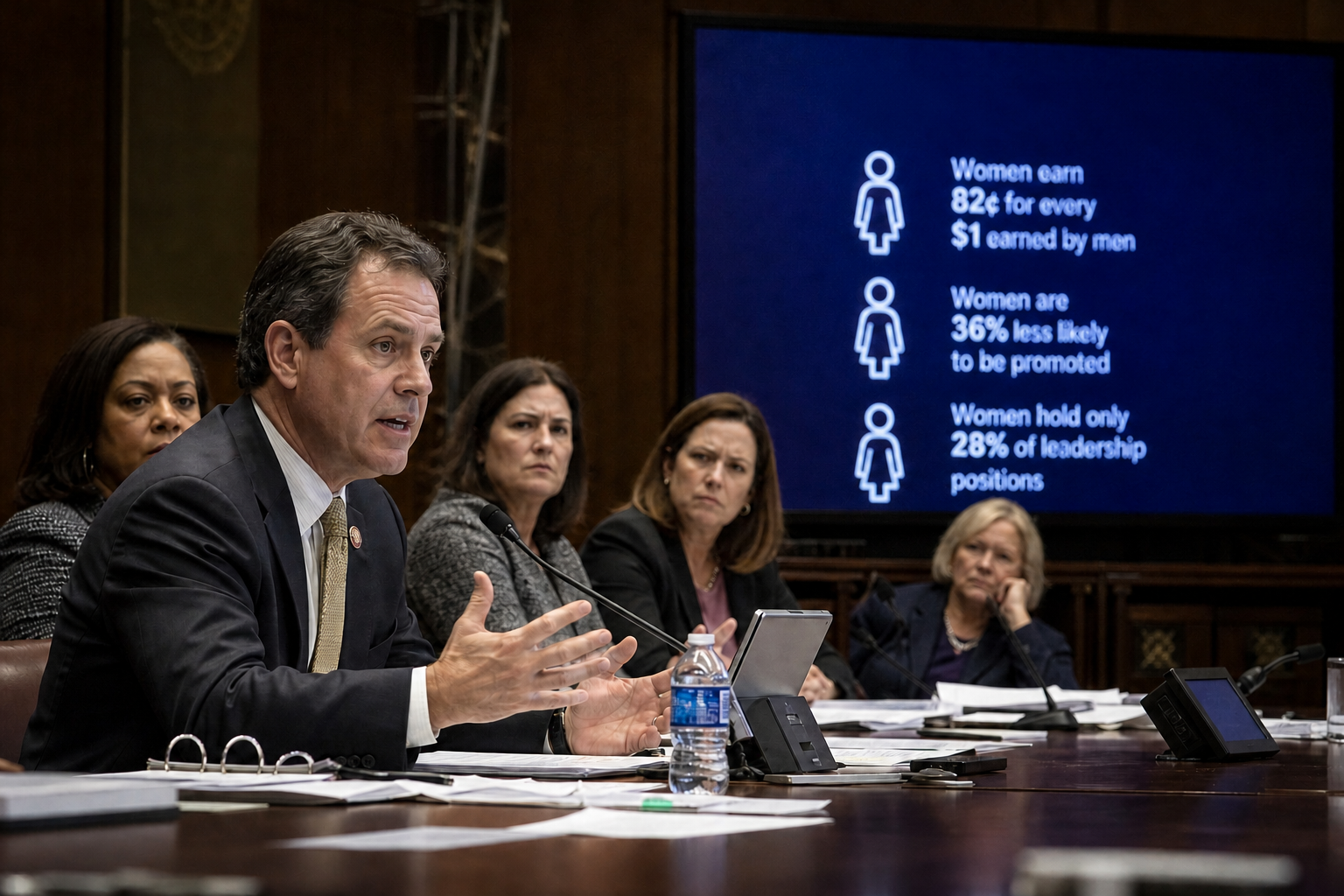
Last month, a state representative here in Pennsylvania said out loud what too many hiring decisions only imply. At a September 29th House Labor and Industry Committee meeting on House Bill 2135, which would require employers to make reasonable accommodations for pregnancy and menopause-related conditions, Rep. Scott Barger argued the bill would make women more expensive to hire. He said employers weighing a woman and a man in their mid-40s would "find reason not to hire the woman." Then he said he would do the same.
The clip went viral. The bill advanced out of committee anyway, 14 to 12.
I have signed the front of a paycheck too. I have been a CFO, built the budgets, and sat in the hiring conversations. My read of the numbers is the opposite of his: treating women as a cost line is what gets expensive. The newest research, the policy shift in Europe, and what benefits leaders are saying about menopause all point the same direction.
The pipeline breaks early, and quietly
Most bias is never said into a microphone. It shows up in the data, which is why I use sources like Lean In and McKinsey’s Women in the Workplace report. The latest edition, its 11th, draws on more than 120 companies and 9,000 employees. Five findings every finance and HR leader should know:
- The broken rung still holds. For every 100 men promoted to manager, 93 women were promoted. For Asian women and Latinas it was 82, and for Black women, 60.
- Sponsorship starts uneven. Only 31% of entry-level women have a sponsor, compared with 45% of entry-level men.
- For the first time, there is an ambition gap: 80% of women want to be promoted versus 86% of men. When women get the same career support as men, the gap disappears.
- Six in 10 senior-level women report frequent burnout, compared with about half of men at their level.
- Flexibility carries a penalty for women only. Among women working mostly remotely, about a third were promoted in the last two years, versus more than half of women working mostly on-site. Men’s outcomes barely change by location. Meanwhile, 1 in 4 companies scaled back remote and hybrid options this year.
- Share the starting salary or pay range in the job posting or before the interview, and stop asking candidates about their pay history
- Give employees, on request, their own pay level and the average pay by sex for people doing the same work or work of equal value
- Publish gender pay gap information if they have 100 or more employees
- Run a pay assessment when a gap of 5% or more cannot be justified
That last point connects to what I wrote about overwork and capacity. When organizations cut flexibility and headcount at the same time, the load lands on the people already carrying the most, and the data says many of them are senior women. That is a retention risk with a real cost attached, whether or not anyone puts it in the forecast.
Europe is legislating what the data already shows
After a recent call, Eline Ketelaars, a fractional General Counsel working across Europe, pointed me to the EU Pay Transparency Directive. EU countries had until June 7, 2026 to write it into national law. Under the new rules, employers must:
-
Share the starting salary or pay range in the job posting or before the interview, and stop asking candidates about their pay history
-
Give employees, on request, their own pay level and the average pay by sex for people doing the same work or work of equal value
-
Publish gender pay gap information if they have 100 or more employees
-
Run a pay assessment when a gap of 5% or more cannot be justified
The burden also shifts. An employer that misses its transparency obligations has to prove there was no pay discrimination. The UK is not bound by the directive, but its own guidance released this spring already recommends pay information in job postings.
Although many countries within the EU are already late, and yet to transpose the Directive, employers should definitely make sure that they are prepared when the laws hit, specifically those with employees in different countries. The pre-hire transparency and the right to information will kick in for all employers, big and small, on the day of entry into force.
What stands out from a finance seat: none of this is new work. It is what a well-run finance and HR function should already be able to produce. Documented pay bands. Consistent job categories. Clean payroll data. A clear reason for every exception. The directive simply makes it auditable.
Pennsylvania is still debating the basics
Women in Pennsylvania earned 82.4% of what men earned in 2024, according to the U.S. Department of Labor, a gap wider than the national average. House Bill 630 would update the state’s equal pay law for the first time in decades, bar employers from using salary history to set pay, and protect employees who raise pay concerns. It passed the House by a single vote in May 2025 and has been sitting in the Senate Labor and Industry Committee ever since.
So, in the same year Europe moved to require pay transparency, Pennsylvania lawmakers were still debating whether accommodating a normal stage of life makes women too costly to hire.
Menopause is a workforce issue, not a footnote
The timing of the Harrisburg comment stood out to me because I had just attended SHRM’s webinar, Menopause at Work: Choosing the Right Benefit for Your Population. The session made a point every finance leader should hear symptoms go well beyond hot flashes, to brain fog, sleep disruption, joint pain, and mood changes. Most women manage them alone, moving between specialists, while the employer absorbs the cost of that gap through lost productivity, absences, and turnover.
This week, The Female Lead shared early results from a major study on perimenopause. Hot flushes, the symptom most people picture, ranked only 18th, and 29% of women said they never have them at all. The signs they highlighted instead include new anxiety, word-finding difficulty and trouble concentrating, and aching joints. At work, those can look like a confidence problem or a performance problem. Perimenopause can also start earlier than many women expect, which means many are navigating it during their peak earning and leadership years, often without naming it.
That is the population Rep. Barger described as a hassle. It is also the population carrying a large share of institutional knowledge and senior leadership. It is why I have been developing Rhythm & Results, a cycle-aware approach to supporting women at work. It is still a work in progress, and every conversation like this one confirms how needed it is.
What leaders can do now, no new law required
- Know your numbers. Run a pay review by role and level. If your job categories are inconsistent, fix that first. Good analysis needs a clean foundation.
- Publish ranges and stop asking for salary history. Philadelphia employers are already barred from asking about pay history, and the EU now requires ranges up front. It is quickly becoming the baseline.
- Track who gets sponsored, stretched, and promoted, not just who gets hired. The broken rung is visible in your own data if you look.
- Write down your accommodation process before you need it. A clear, consistent process protects employees and the organization, and it takes the guesswork out of hiring managers’ hands.
- Measure flexibility on outcomes, not location. If remote women are being passed over, that is a process problem, not a performance one.
- Review your benefits through a life-stage lens. Ask whether your plan covers menopause care and whether managers know how to respond when someone asks for support.
- Build it into the culture. Policies only work when people feel safe using them. That means managers who can have the conversation, and a culture where asking for support is not treated as a risk.
People-first and financially sound are not competing goals. They come from the same discipline: clear data, consistent processes, and leaders willing to look at what the numbers actually say.
If you want a second set of eyes on your pay data, structures, or policies, book a conversation with me.

Sources
- Lean In and McKinsey, Women in the Workplace (11th edition): https://leanin.org/report/women-in-the-workplace/
- European Commission, New EU rules on pay transparency explained (June 5, 2026): https://commission.europa.eu/news-and-media/news/new-eu-rules-pay-transparency-explained-2026-06-05_en
- Pennsylvania Capital-Star, commentary on HB 2135 hearing: https://penncapital-star.com/uncategorized/what-girls-hear-when-a-lawmaker-calls-women-more-costly-to-hire/
- The Mary Sue, HB 2135 committee vote: https://www.themarysue.com/gop-rep-scott-barger-discusses-menopause-accommodations-in-hearing-then-says-he-would-find-a-reason-not-to-hire-the-woman-problematic/
- Rep. Liz Hanbidge, Equal Pay in Pennsylvania (March 2026): https://www.pahouse.com/Hanbidge/EmailArchive/?id=142933
- Bird & Bird, Is Pay Transparency Coming to the UK?: https://www.twobirds.com/en/insights/2026/is-pay-transparency-coming-to-the-uk
- The Female Lead, 7 signs of perimenopause (LinkedIn, October 2026): https://www.linkedin.com/posts/thefemalelead_7-signs-of-perimenopause-activity-7516203723430227969-0_7w
- SHRM, Menopause at Work: Choosing the Right Benefit for Your Population: https://www.shrm.org/events-education/education/webinars/menopause-at-work-choosing-right-benefit-population