
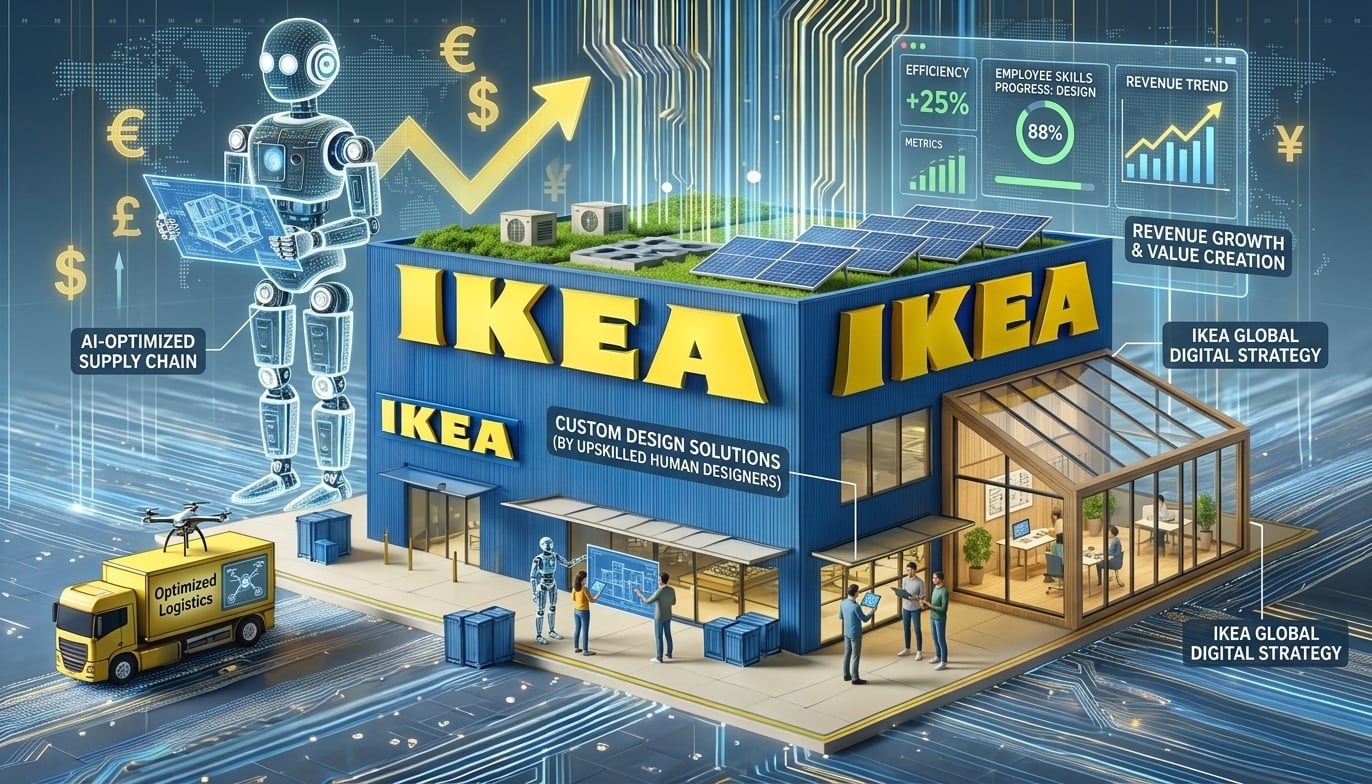
We keep hearing how AI is changing the workforce, industries, and daily life. META released Muse just this month to help book travel, send emails, help you shop and manage your schedule. Workshops online focus on helping you build AI agents for your website and small ticket items to help reduce the daily load. But when AI makes all things equal, what will make you stand out? I think the IKEA approach highlights that answer.
The IKEA problem
In 2021, IKEA’s parent group, Ingka, decided to introduce an AI chat bot system into the business. This AI bot, named Billie, was designed to be able handle the routine customer service questions like “where’s my order” or “what is your policy on X”. Within its first two years of implementation, Billie was resolving about 47% of customer enquiries, handling roughly 3.2 million interactions and saving IKEA around €13 million.
This now created an obvious problem... what happens to the thousands of employees whose work had just been automated? At the time, IKEA had around 8,500 call-center employees affected by the change. Now what IKEA did, I think, happens to be a very forward-thinking move. Instead of simply making those employees redundant, IKEA spent approximately two years retraining them.
IKEA took a very simple approach to this improvement by AI in its low-value customer service work, and asked the question, “what can Billie not do well?” and discovered that whilst AI was great at solving simple issues, the more complex questions still required a human. So, IKEA retrained many of its customer-service employees to become remote interior design advisers. By doing this, they created a whole new revenue generation stream which by FY2022, the remote interior design channel generated approximately $1.3 billion in sales, representing about 3.5% of IKEA's total revenue at the time. More recently, IKEA has reported approximately $1.25 billion in annual sales through its remote-sales centers. This remote-sales operation has also become one of IKEA's fastest-growing sales channels, with reported annual growth of around 15–20% over the past three years.
Move people up the value chain
So how do we employ this kind of innovation in our own businesses? Most businesses aren’t the giant corporations the size of IKEA, but the use of AI, and upskilling those in the business can still have similar effects.
The goal of AI is to remove mundane, repetitive work and allow people to focus on higher value, business driving elements. The first step to this is to look at individual tasks rather than jobs. Many tasks that take up valuable time, such as entering data or answering repeat questions, can be done through the help of AI. This certainly doesn’t mean your employee is no longer needed, but it does give them extra capacity than can be used in a better way.
It gives your teams the time and opportunity for personal development which wasn’t there previously. As the capacity becomes available, employees can learn new skills and take on more valuable responsibilities. A customer service employee can spend less time answering basic questions and more time building customer relationships. A marketing employee can spend less time updating dashboards and more time looking at what customers want and need. A finance employee can spend less time rekeying data and more time helping the business understand its budgets, cash flow and profitability.
The most important point is that businesses should stop looking to replace humans with AI and instead shift that focus to creating more capacity in the workday. Give your people more time to think and time to learn and grow. If AI saves an employee ten hours a week, the business should ask what can be learned in those hours? What proactive steps can we take to engage our clients? Can our team speak to more customers? Can they attend a webinar and learn how to improve the sales process? Can they deliver a new service? Can they solve problems that were previously sidelined? The real value comes from turning saved time into better work for the employee and, ultimately, better results for the business.
The IKEA model shows us that AI does not have to make employees less valuable. It removes the barriers that their old tasks created and gives them the opportunity to do more important work. For small businesses, the question should not simply be, "How much can I replace with AI?" A better question is, "If AI gives our people more time, what can they achieve?"
